So you've learned the basics of Yajilin and played a few games. It was fun, right?! But then you open up the Puzzverse leaderboard and see someone solving it in 43 seconds, while you're sitting there at 8 minutes wondering if they hacked the app.
Completely understandable!
That's exactly how most of us start out. Having that motivation to write your name on the leaderboard someday is what makes it exciting. But those top players aren't doing magic - they've just practiced enough to spot a few common patterns instantly.
Today, I'd love to walk you through the four most common patterns in Yajilin - the ones that fast solvers recognize almost immediately.
Let's start with the basic ones!
Pattern 1 · The Edges
I mean, that's typically the very first step a lot of solvers do - walking the edges of the grid. Why? Because the corners and borders are the most squeezed, constrained spaces on the board.
Let's go back to our two golden rules: "No kittens next to each other" and "No dead ends", right?
Look at the grid below. What if I place a kitten (a shaded cell) on those highlighted cells? What will happen?
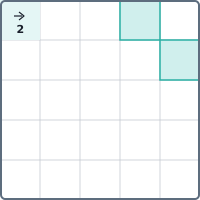
Look how we will end up with a dead end!
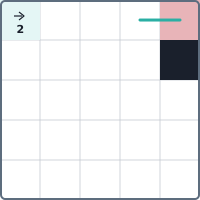
Edges give you this leverage precisely because everything is so squeezed there. Start your scan from the corners. Mark the cells next to edges as un-shaded. This logic is really helpful, as it marks a lot of dots (safe cells) so we can quickly eliminate options and choose where to actually shade!
Here are some practice puzzles:
Pattern 2 · Rows & Columns Without Enough Space
This one is classic, and honestly really simple to ignore when you're caught up in the puzzle.
Look at the Yajilin below. For the highlighted clue, there's literally only one possibility for it. If a clue says 2 shaded cells to the right, and there are only 3 available cells in that direction, you don't have two possibilities. You have exactly one!
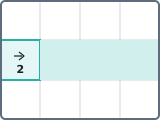
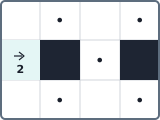
Deduction — only one valid arrangement
💡 The tighter the space, the more you gain. A clue with n shaded cells in n+1 available cells? That's a fully determined row. No thinking needed.
The first two patterns in a combined way itself opens up a lot of new possibilities.. look at the below puzzle..
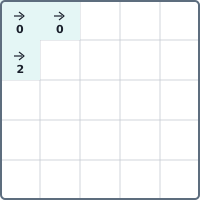
Even though there are two possibilities for shaded cells in the second row.. if you combine rule one.. you will quickly eliminate one! Can you??
Some Yajilin examples using Pattern #2:
Pattern 3 · The Pitfalls
This is an interesting one, and we use it quite often when we see "pitfalls" as I say... or narrow alleys.
Imagine your loop narrows to a single cell wide. What happens to the cells next to that narrow passage? You can quickly mark both the cells right next to it as un-shaded. Why?
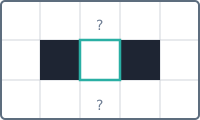
Because if you put a kitten (shaded cell) in either of those spots with the question marks, the path has nowhere to go - it'll be a dead end! Since the loop has to pass all the way through, you can safely mark those dots.
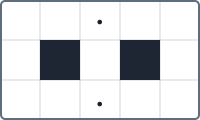
Deduction — both the cells next to alleys must be un-shaded!
This deduction is very common and widely used, even though I took an easy example to explain but you can try extending it to various cases wherever placing a shaded cell might just block the path.
I'm sharing one example of how the rules get implemented in various puzzles (try spotting the logic in the space above 1):
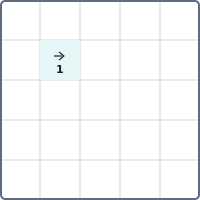
This one becomes almost automatic with practice. Your eyes start scanning for narrow gaps first!
Some example Yajilin:
Pattern 4 · Odd/Even Endpoints (Advanced!)
Now this one is kinda advanced, but I included it here because this is a very generic pattern applied to almost all of the loop-based puzzles. It's the most powerful pattern in the list!
Let's start from basics.
What's a loop? A loop has no edges, no junctions, no branches, no dead ends. Everything is connected.
Now think, what if I give you 3 end points in an enclosed space (highlighted region)? Can you make a loop?
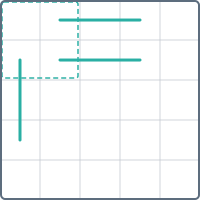
It's not a closed loop!! It has branches/junctions.
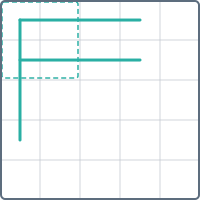
What makes a closed loop possible? You need an even number of connection points in any enclosed region. Every time the loop enters a region, it must also leave. Entry + exit = always a pair.
So I ask you to think: what if I give you 3 end points in an enclosed space? Can you make a loop out of them? Or 1, or 5, or 7? It's just not possible. The math doesn't work. Odd crossings = the path can't close.
Back to basics... to make any loop closed, we need to have an even number of endpoints!
What does that mean for Yajilin?
"We always need an even number of endpoints in an 'enclosed space' to make a loop."
Now I deliberately used "enclosed" because the scope of the space is totally up to you! It's a very dynamic pattern - it depends on where you are looking. Let's look at the classic example below.
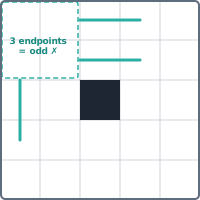
Setup — the dashed region has 3 endpoints crossing into it. Odd number — something must change.
If you look at the area I've outlined with dashes, that is the enclosed space for me right now. We already have three endpoints poking into it! And as we know, in any enclosed space, I need an "even" number of endpoints... so I absolutely need one more edge/loop to enter the area from somewhere.
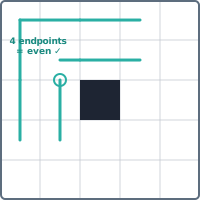
Deduction — a 4th crossing is forced (circled), which locks the loop's direction in that area
Now look at the circled cell! While we were completely clueless before about where the line should take a turn, now we are super clear that it must turn and enter the enclosed space to make it an even 4. That is incredibly satisfying!
Bringing it all together
These are the basic common patterns. We've got a few more advanced ones, but they are all built up right on top of these. I think the best thing to do now is head back to the Yajilin tab, open up some older ones you've already solved, and just try to spot these patterns. Don't even try to rush, just see if you can find the narrow alleys and edges!
Go find some kittens.
All the best, see you soon on the leaderboard!